
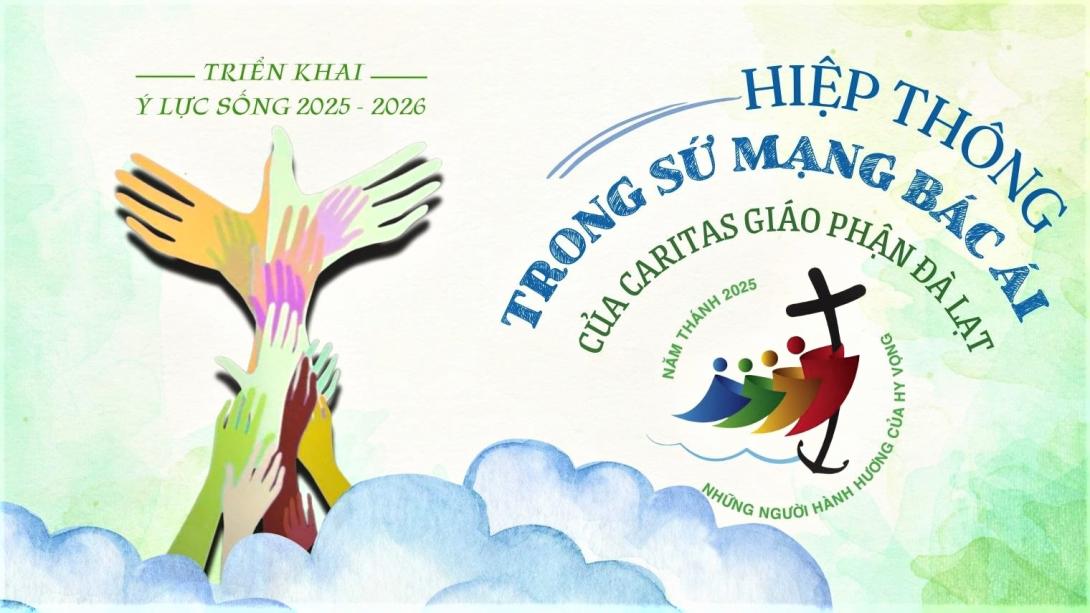
WILL TO LIVE IN 2025 - 2026
TOPIC: COMMUNITY IN THE CHARITY MISSION OF CARITAS OF DA LAT DIOCESE
In order for all of us to enter into the life theme: "Communion in the charitable mission of Caritas Diocese of Da Lat", let's learn the basic things that make us obligated to communicate in the charitable mission: What is communion? Where does communion come from? What is the charitable mission of Christians? From there, it leads to the charitable mission of Caritas Vietnam and Caritas Da Lat and finally invites members to join in this mission.
I. What is communion?
The Catholic dictionary defines communion as follows: “union: together”; "communication: harmony together". Communion is: the parties are in harmony with each other.
Communion has the Greek root koinonia: brotherhood, sharing, participation.
Communion is Christians living in a close relationship with Christ and with each other. With Christ, Saint Paul in 1Cor 1:9 wrote: "God is faithful, who has called you to communion with his Son, Jesus Christ our Lord"; 1 John 1:3 writes: "What we have seen and heard we announce to you also, so that you also may have fellowship with us, and we have fellowship with the Father and with his Son Jesus Christ." Because from the beginning, God has continuously invited humans to unite with Him (CCC 27).
II. Baptism is the foundation for communion.
- The Second Vatican Council in its Constitution on the Church Lumen Gentium affirmed that in the Church there is a profound communion between all baptized people: all have the same Lord and the same Spirit, forming a single body; all share the same faith and the same baptism, the same gift and calling, and the same responsibility and work (LG 32).
- CCC No. 871 writes about Christians as follows: "Christians are those who, incorporated into Christ through Baptism, are established as the people of God, and therefore participate in their own way in the priestly, prophetic and kingly office of Christ, called according to each person's own conditions to carry out the mission that God has entrusted to the Church to complete in the world...".
- In the Handbook of the Synod of Bishops (Synod) 2021-2024 "For a Church in Companion: Communion - Participation - Mission" to guide on synod, the Synod explained synod as follows: "Thanks to the Sacrament of Baptism, we are all called to actively participate in the life of the Church. In parishes, small Christian communities, lay movements, religious communities, and other forms of communion men and women, young and old, we are all invited to listen to one another to discern the impulse of the Holy Spirit, who comes to guide our human efforts, to breathe life into the Church and to lead us into deeper communion for our mission in the world.
Thus, Baptism is the foundation for communion, it brings us into communion with God and Man. Communion invites participation in the mission and life of the Church. Communion, participation, and mission are three elements that go together and cannot be separated. It is impossible to talk about communion without having to do with two aspects: participation and mission.
III. The Christian mission of charity.
Based on Jesus' teachings: "Love one another as I have loved you" (John 15:12) and the Gospel of Matthew chapter 25 about the day of judgment, as well as the parable of the Good Samaritan who helped the man who was exploited by robbers, shows the Christian's mission of charity. This is not a call to charity but a duty to practice charity in the lives of Christians and therefore the very mission of the Church.
The Gospel of Mt chapter 25 about the judgment scene speaks to the essence of why we must serve the poor and why the Church chooses to give priority to serving the poor. Jesus is inviting us to recognize a mystery: the hungry person, the stranger, the imprisoned person: is a unique human being, precious not only in his or her own right – but also at the deepest core of human nature. The Lord is there, speaking His words, dwelling among us again in the flesh, carrying with Him the desire to live and love” (see Spirituality of Charity, 2009).
The Decree on the Adaptation and Renewal of Religious Life - Perfectae Caritatis - also reminded the congregation to use its assets to help the poor; The decree on the ministry and life of priests also mentioned the poor life of priests. Follow the example of the poor Christ, and also follow the example of Saint Paul who always works and helps those in need.
IV. Caritas's charitable mission.
Caritas Vietnam Office together with Caritas 27 dioceses have worked together to carry out the mission of the Church, bringing the Gospel to everyone through the practice of charity, especially the poor and those abandoned on the margins of society. In that spirit, the Caritas Vietnam office together with Caritas 27 dioceses has oriented and implemented many projects such as education promotion, life protection, environmental protection, support for people with disabilities, mentally ill people, HIV.AID, relief, immigration, human trafficking prevention, installation of clean water systems... In particular, Caritas Vietnam as well as the dioceses are constantly expanding their network, disseminating spirituality, and the mission of Caritas to parishes, because this is mission of Christians. (excerpt from Communion 144: opening statement of the Social Committee-CARITAS Vietnam)
The apostolic exhortation Vita Consecrata calls the poor the oppressed, the marginalized, the elderly, the sick, children, all those who are considered and treated as the last in society.
The final document of the Synod of Bishops on Synod No. 19 reads: “In God's heart there is a special place for the poor” (NVTM. EG 197), the marginalized and the excluded. Therefore, they are also in the heart of the Church. In them, the Christian community encounters the face and body of Christ, who, though rich, became poor for us, so that we might become rich through his poverty (see 2 Cor 8:9). The preferential option for the poor is implicit in faith in Christ. The poor have direct knowledge of the suffering Christ (cf. NVTM, no. 198), which makes them messengers of salvation, received as a gift, and witnesses of the joy of the Gospel. The Church is called to be poor with the poor - often the majority of the faithful - and to listen to them, learning with them how to recognize the charisms they have been given by the Holy Spirit. The Church also needs to learn to recognize them as agents of the proclamation of the Gospel.
With the orientation: TO THE POOR of the 2023 Caritas Vietnam Congress held in Kontum diocese, Caritas members have walked together, shared and accompanied the poor in terms of material, health, knowledge, spiritual life, and even social relationships. These people not only face economic difficulties, but also encounter many mental and psychological barriers and isolation in the community. (from Communion 144, opening statement)
V. Charitable activities of Caritas Da Lat.
1. In parishes, Caritas depends on initiatives and conditions to do charitable and charitable work, including combining charitable activities with organizations...has done many different charitable works...
2. Programs run by Caritas Da Lat office: Diocesan study promotion, study promotion from Caritas Vietnam, Bright Path scholarship, Micro-credit program, People's Self-Development program, participating in serving the mentally ill in Trong Duc, protecting life, protecting the environment, supporting people with disabilities...
VI. Communion in the charity mission of Caritas Da Lat.
As we mentioned above, communion comes from the Greek word koinônia, which describes brotherhood, friendship, sharing, and participation. It is about Christians living a relationship with Christ and with each other. Therefore, communion in the mission of charity is always participatory. Communion and participation in this mission are diverse in both spirit and specific activities.
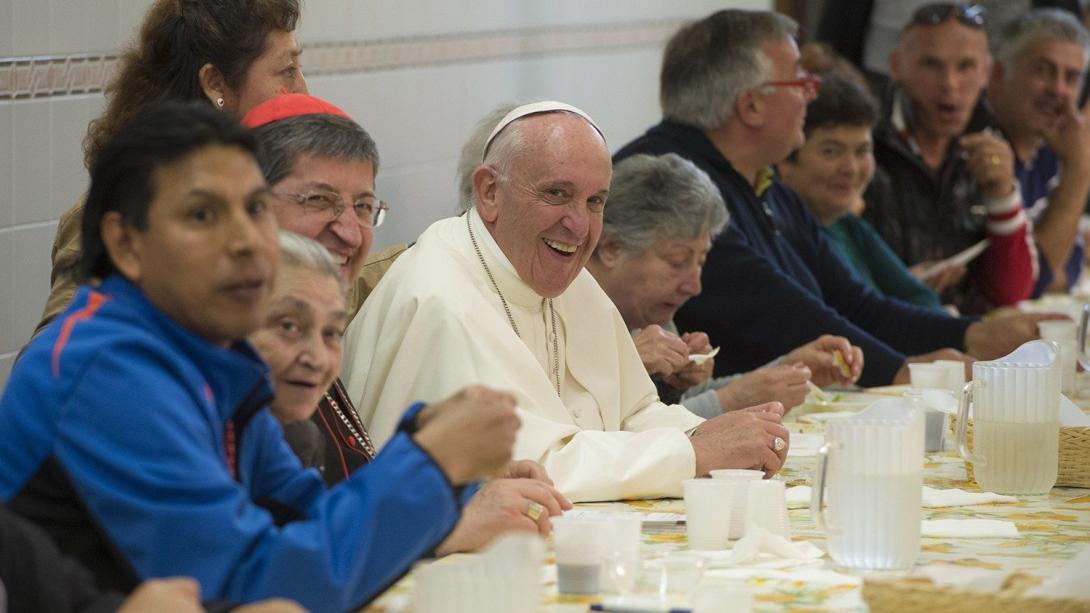
- Communion in spirit when focusing on charitable activities: like listening to Christ and listening to each other. Listen to Christ in prayer, because meeting God is the foundation and key to communion, and at the same time, when we meet God, we will also easily meet the people who are the objects of Caritas' charitable mission. Listening to Christ, we will feel moved to participate with action in the programs of diocesan Caritas. Besides, spiritual communion also requires listening to each other in charitable activities. By listening, we can understand and from there communicate with each other in love. Not only communion in work, but above all, communion in love. Love and service always go together. Love leads to service, and service is the clearest and strongest expression of love. Only when we love are we willing to serve and reach out to those who are served selflessly. Pope Francis always acts for the weak and teaches us to have a kind heart so we can care for the poor.
When we join in Caritas' charity mission, reaching out to others will be a way to extend and spread God's love, especially to the poor. Today people need to share not only material things, but also love, understanding, and sincere words of sympathy and encouragement.
- Communion in charitable activities
In the Gospel passage of Matthew 25 about the day of judgment and the parable of the Good Samaritan, charity will not only stop at the spirit but motivate us to take specific actions: feed the hungry, give drink to the thirsty, give clothes to rags, visit the sick and in prison, get help in need... Communion in specific charitable activities sometimes requires us to commit, not afraid of difficulties, willing to sacrifice time and health to share. share, care, accompany. A very specific example that we will never forget during the Covit19 pandemic, so many people shared and contributed to the epidemic area and patients.
Pope Francis in a letter to the Vietnamese Catholic community on the occasion of recognizing the Agreement on the Statutes for the Resident Representative of the Holy See and the Resident Representative Office of the Holy See in Vietnam (September 8, 2023), wrote: "Today, more than ever, we need to practice charity in a concrete way, that is, to have a concrete decision to act for people, as was done in the mystery of the Passover and constantly demonstrated by the Church throughout history." history, because "in every place and in any situation, Christians are invited to listen to the cries of the poor" (TH.NVTM n.191). It is this spirit that has constantly motivated your Catholic community to make positive and meaningful contributions to serve the nation, especially during the Covid-19 pandemic."
He also recalled the pastoral letter of the Vietnam Conference of Catholic Bishops that reminded and encouraged God's people to "Participate in community life through loving each other, sincerely listening and practicing charity, even with brothers and sisters who do not share the same faith, by caring for the weak and the most suffering."
Conclusion: Dear Caritas Da Lat members,
We are living in a Holy Year of Hope. Our hope is in Christ, who identified himself with the poor when he taught us that doing good to the poor is doing it for God. That motivates us to live in charity and communion in the charity mission of the Church in general, of Caritas Vietnam and Caritas of Da Lat Diocese. This communion has a spirituality and the spirituality of communion teaches us:
- Contemplating the mystery of the Trinity in our hearts through the Sacrament of Baptism, to be able to see God in the faces of our brothers and sisters around us.
- Seeing in faith that we and our brothers and sisters are united in the Mystical Body of Christ, thereby giving us the ability to share the joys and sufferings, desires and needs of our brothers and sisters, knowing how to "bear each other's burdens".
- See the positive in others, including the poor, accept it as a gift from God to them and also to yourself.
| File The will to live Caritas GP. Dalat 2025 - 2026.docx (29.45 KB) |