
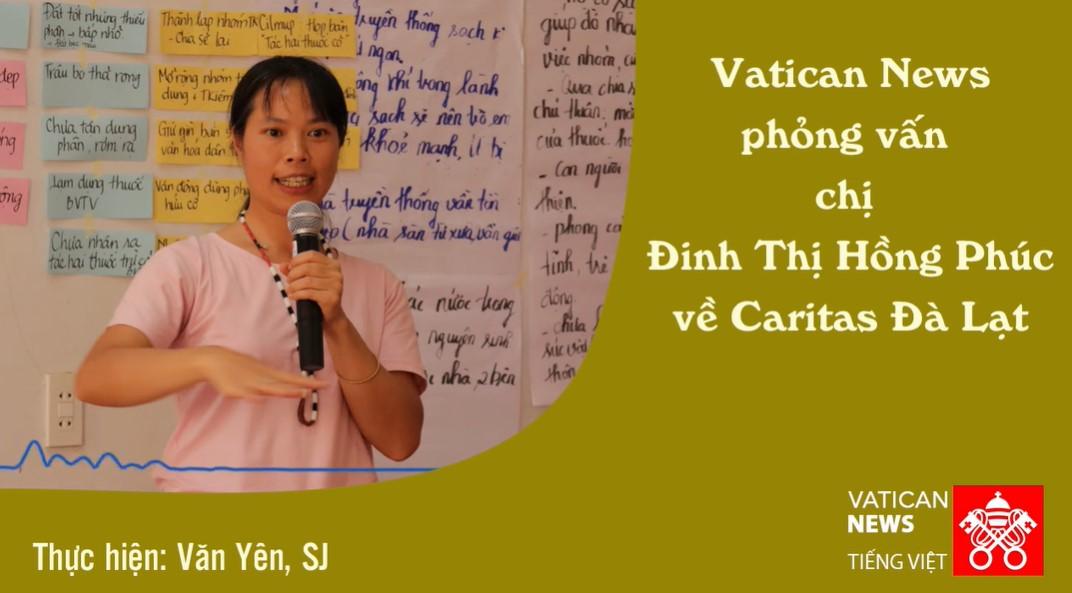
Vatican News interviewed the deputy director of Caritas Dalat Implemented by: Van Yen, SJ
Pope Francis is always interested in the charitable dimension of the Church. Especially on environmental issues and development for the poor. Vatican News had an interview with Ms. Dinh Thi Hong Phuc, deputy director of Caritas Dalat, about the activities and commitments of Caritas Dalat.
Interview content
1. Please give a brief overview of Caritas Dalat's activities.
Caritas Dalat is entering its 11th year this year. Caritas Dalat's activities are focusing on the following areas: - Establish, maintain and strengthen the Caritas parish and district network. - Development programs for ethnic minorities: micro-credit programs, sustainable agriculture in the direction of natural ecology, preserving national cultural traditions, respecting indigenous knowledge and preserving resources.- Program to Support persons with disabilities to Integrate into the Community: Accompanying to improve the capacity of disabled people's associations of the province, district and Dalat city in soft skills related to organizational leadership or positive living thinking. At the same time, Caritas Dalat coordinated a number of support programs for wheelchairs, wheelchairs, artificial limbs, as well as monthly rice rations for 755 persons with disabilities, lonely elderly people and people in special circumstances.- Life Protection Program: raise awareness for teenagers and mothers about protecting life through training sessions, communication sessions, and seminars specializing in life skills, life values, Billings method, and how to raise children. - Comprehensive development support program for mental patients in Trong Duc social protection facility in social and medical fields. - Other medical and charity programs.
2. What is the number of employees and specialists of Caritas Dalat and what are their jobs?
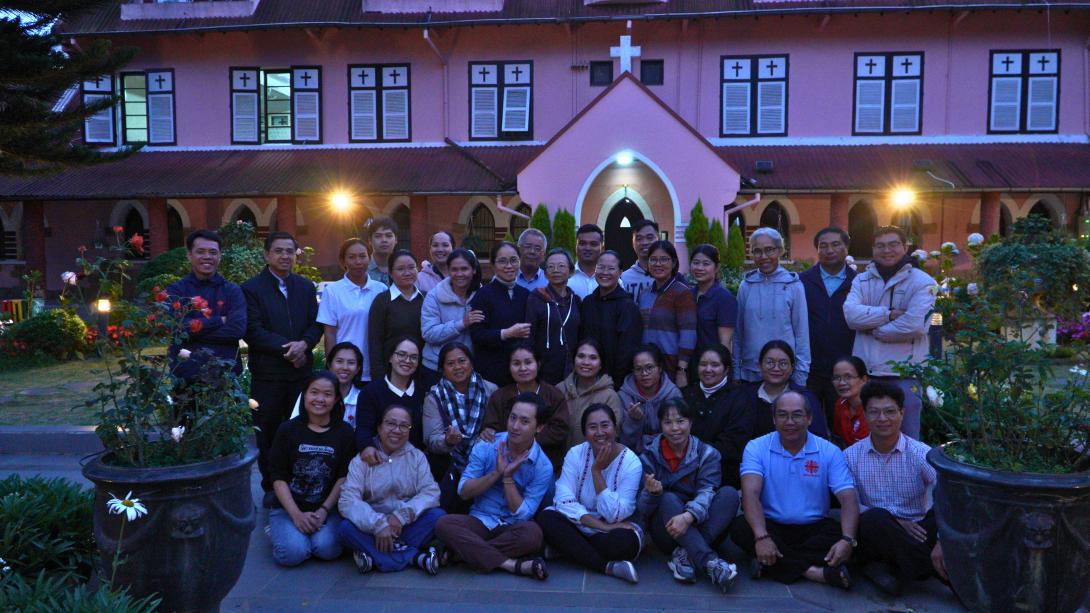
Caritas Dalat currently has a director and 23 full-time staff. Qualifications and expertise are diverse, from intermediate to graduate school, in the fields of health, society, agriculture, foreign languages, and some are teachers. Of these, there are 6 staff working in the office responsible for programs on disabilities, health care, life protection and administration, 5 staff serving full time at the Trong Duc facility, and the remaining staff are ethnic minority staff working in communities in the villages.
3. What is the development direction of Caritas Dalat?
Caritas Dalat focuses more on People's Development: a form of development in which people are the center and agents of change. This is also the direction that Caritas Dalat wants to apply in all other activities. Caritas Dalat also clearly determined: the Caritas parish network with a large team of volunteers can do well things related to distributing charity gifts. Diocesan Caritas will go deeper into long-term and comprehensive development programs, sustainable programs that take a long time to create change.
4. What is the collaboration between Caritas Dalat and other organizations like?
No one is an island. Caritas Dalat is the same, first of all through the solidarity between Caritas in different dioceses. Caritas Dalat has introduced the People's Self-Development program to a number of other dioceses, and is accompanying Caritas Phan Thiet in the initial steps of implementing the project. Next, Caritas Dalat has relationships with a number of non-governmental organizations in northern Vietnam. Although they do not have the same religion, employees and people in organizations can exchange and learn from each other.This has helped Caritas Dalat have a more open view in its approach to the community and in other areas of activity. The Central Highlands people are able to learn and apply a number of ways to manage forests and natural resources based on customary law as well as different community solutions to climate change; Especially the northern regions also changed a lot.In addition, relationships with donors like Misereor also connect Caritas Dalat with other networks of organizations with the same direction in the Southeast Asia region in exchanging learning and experiences or regional forums in the process of motivating people to create change.
5. Do you have any concerns about Caritas Dalat in general and about natural agricultural development in particular? Is this direction related to Pope Francis' encyclical Laudato Si?
Today, the pursuit of modern agriculture, planting new varieties, using fertilizers and chemicals has gradually degraded the land, polluted water sources and lost local seed sources. Farmers are no longer proactive in input materials like before and they become slaves on their own land. Many people were so in debt that they couldn't get out of it and had to sell their land to pay it off.Faced with this situation, as well as through the call of Pope Francis through the encyclical Laudato Si, Caritas Dalat is very eager to accompany farmers so they can reaffirm their rights in traditional farming. In it, farmers keep and exchange traditional seeds, cultivate in a natural direction, say no to herbicides, intercrop, multi-crop, and use available materials that the Creator has given them to compost to enrich the soil. Furthermore, with collective activities the community increases its strength and solidarity.At the same time, people are encouraged to revive cultural and spiritual traditions that have been associated with long-standing life in the community, such as harvest holidays, planting crosses in fields, and rituals of offering the Baby Jesus seeds that they themselves will sow in the next crop. Besides, finding and connecting markets so that farmers' products directly reach consumers are also specific things that Caritas Dalat is doing. The value chain of products made according to a fair process, respecting the environment, and in harmony with nature is gradually being recognized.PGS (participatory guarantee system) standards in the quality control system are being researched and applied. Finally, to spread and increase the strength of this upstream direction, Caritas Dalat aims to replicate the model, link and network to many different communities, many different networks so that people can be encouraged, exchange and learn together and inspire each other so that the movement can multiply even more.
6. What is the productivity of natural development?
When done in a natural way, if you aim for productivity, it will not be as good as using fertilizers and chemicals, and the length of the crop will not be as short. For example, when using growth stimulants, a normal growing season takes about 30 days, while using growth stimulants takes about 21-25 days. Certainly, when done naturally, the yield is not as good as using chemical fertilizers. However, in terms of durability in the future, it will have durability for the tree. For example, coffee will not have a great yield, but the coffee tree will bear more fruit and be more durable.As for vegetables, they can be stored thanks to the nutritional balance in the natural soil so they can be preserved longer. So its value must be higher. For example, for vegetables grown organically, the gardener must receive at least 15k, while when using chemical fertilizers and mass planting and selling to traders, sometimes people only receive 3k/kg.
7. Please tell us how this direction was formed?
This is a very long time of traveling and learning. At first, I couldn't imagine, and also couldn't believe, that small and fragmented organic agriculture could be the direction for farmers. But the more I walk, the more I see that God is leading me, but I have no idea how it will be from the beginning.Experience is that from the first time Caritas persuaded a growing household to try not using pesticides, not to mention chemical fertilizers, that is, still use a little urea and chemical fertilizers, Caritas had to convince them for 6 months before one household tried it out, curious to see what it was like. Because when people get used to using chemical fertilizers, they get used to the concept that plants cannot grow without using chemical fertilizers. When they learned about Miserior, they connected themselves with Caritas Asia in Asian seminars for farmers.From there, I had a concept of what sustainable agriculture was and started to research and go to Caritas Changmai, Thailand to learn. Then through these and other organizations abroad, we saw that farmers in other regions had already done it, so slowly we could see the direction.
8. What is Caritas Dalat's contribution to the vitality of the Diocese?
"Proclaiming the Gospel - Celebrating the Sacraments - Practicing charity" are the three duties of Christians mentioned by Pope Benedict XVI in the message "God is Love". Therefore, social charity activities - or the role of Caritas in the diocese - will help proclaim the Gospel come alive and be a way to realize the Sacraments in life. When lay people are invited to share food and clothing with each other, they are multiplying and giving life to the body of Christ in the Eucharist. When people know how to work together in the community, they will live the Gospel values more thoroughly, ignoring personal interests to share with those who are less fortunate in the community.